


Facilities and maintenance work is one of the most varied jobs in any building. In a single shift you might be up a ladder changing a light fitting, kneeling under a sink, walking miles of corridor on a patrol round, and stepping into a wet plant room. That variety makes footwear choice genuinely difficult, because one shoe has to cope with several different environments in a day.
This in-depth guide covers the real hazards, what to look for, one critical safety distinction most people get wrong, and where an S1P safety trainer fits, and where it doesn't.
The short version
Much facilities and maintenance work happens indoors on dry floors, walking between jobs, kneeling, and climbing — a setting where an EN ISO 20345 S1P safety trainer is often accepted where safety footwear is required. For that work, a lightweight-feeling trainer with a puncture-resistant midsole, a slip-resistant outsole, breathable materials and a flexible sole can be practical and comfortable. But one point matters more than any other: antistatic footwear is not electrical insulation. If you work on or near live electrical parts, you need footwear certified to EN 50321-1, not standard antistatic safety shoes. Your employer's risk assessment always decides.
What makes facilities and maintenance work different?
Most trades have a fairly predictable environment. A warehouse picker walks concrete; a driver walks pavements. Facilities and maintenance staff do something harder, they move between environments constantly, and each one brings a different hazard.
That last point deserves emphasis. Slips, trips and falls remain one of the largest categories of reported workplace injury in the UK, and maintenance staff meet more slip surfaces in a day than most trades meet in a week. A certified slip-resistant outsole isn't a luxury in this job, it's a core requirement.
The most important thing to understand: antistatic is not electrical insulation

If you take one thing from this guide, make it this. It's the single most misunderstood point in safety footwear, and for maintenance staff who work around electrical systems, getting it wrong is dangerous.
Nearly all S1-class safety footwear, including S1P, is antistatic (marked A). Antistatic footwear has an electrical resistance in a controlled band designed to dissipate static charge safely to the ground, reducing the risk of static build-up and sparks. It is not designed to stop you being electrocuted, and it cannot be relied on for that.
As UK safety suppliers put it plainly, antistatic footwear cannot guarantee adequate protection against electric shock, because it introduces only a limited resistance between the foot and the floor.
Genuine electrical insulation is a completely separate standard. In the UK and Europe, EN 50321-1 is the standard that covers insulating footwear for live working, with classes running from 500V up to 36,000V, marked with a distinctive double-triangle symbol. That standard explicitly excludes antistatic and conductive footwear, they are different products for different jobs.
| Property | What it does | Standard | Right for |
|---|---|---|---|
| Antistatic (A) | Dissipates static charge to ground; reduces static build-up and sparks | EN ISO 20345 | General indoor work; most S1P footwear |
| ESD | Tighter, controlled dissipation to protect sensitive electronics | ESD-specific standards | Electronics, some labs and clean areas |
| Conductive (C) | Rapidly conducts charge away from the body | EN ISO 20345 | Explosive atmospheres (never near live electrics) |
| Insulating | Protects the wearer against electric shock during live working | EN 50321-1 | Working on or close to live parts |
If your role involves working on or near live electrical parts, standard antistatic S1P footwear, including XNEXZ, is not suitable for that task. You need footwear certified to EN 50321-1, selected for the voltage class involved, used alongside your other insulating PPE and safe systems of work. Never treat an antistatic marking as electrical protection, and always follow your employer's electrical safety procedures.
What should facilities and maintenance staff look for in a shoe?

Beyond that critical electrical distinction, a handful of features matter most for this trade, and they're shaped by the sheer variety of the work.
- A flexible sole: maintenance work involves constant kneeling, crouching and squatting. A stiff, rigid sole fights that movement; a flexible one bends with the foot at the ball, which makes crouched work far more comfortable.
- Certified slip resistance: plant rooms, kitchens, washrooms and freshly cleaned corridors are all slip surfaces. Look specifically for the slip-resistance marking.
- A puncture-resistant midsole: the "P" in S1P helps protect against screws, nails and offcuts that litter maintenance jobs.
- Low weight: because you cover ground between jobs all day, a lighter-feeling shoe reduces the effort of every step, part of the hidden cost of heavy safety shoes.
- Breathable materials: plant rooms and boiler houses run hot, so an upper intended to reduce heat and moisture build-up is genuinely useful.
- Grip that works on ladder rungs: a defined tread pattern gives better purchase on a rung than a flat, smooth sole.
- A presentable look: facilities staff often work in occupied buildings — offices, schools, hospitals, hotels, where a smart, trainer-like shoe fits the setting better than a heavy industrial boot.
Is S1P the right certification for maintenance work?
In plain terms, EN ISO 20345 S1P combines a 200-joule toe cap, antistatic properties, a shock-absorbing heel, an oil-resistant outsole, and a puncture-resistant midsole. For indoor, dry maintenance work, general repairs, fabric maintenance, light plumbing, fittings, caretaking and building services rounds, that mix maps well onto the actual hazards.
But maintenance is a broad trade, and S1P has clear limits. It isn't waterproof, so persistently wet plant rooms or outdoor grounds work may need S3 or WR-rated footwear. It isn't heat-resistant in the specialist sense, so hot-work areas need footwear rated for that. It isn't insulating, as covered above.
And it doesn't include metatarsal protection for heavy plant handling. If you're unsure where S1P sits among the classes, our guides to what S1P certification means and the S1 vs S1P vs S2 vs S3 ratings explain what each level actually covers.
Slip resistance vs oil resistance, check the right marking
Another common confusion worth clearing up, and one that matters in plant rooms and boiler houses where oil is present. Oil resistance and slip resistance are two entirely different properties, tested separately.
- Oil resistance (FO): means the outsole material can survive contact with fuel and oil without degrading. It says nothing about grip.
- Slip resistance (SR): is the actual traction test - how well the outsole grips wet or contaminated flooring.
An "oil-resistant" sole is not automatically non-slip, so if traction on wet or greasy plant-room floors matters to you - and for maintenance staff it usually does - check for the slip-resistance marking specifically. And remember no shoe grips in every condition; housekeeping, spill control and sole care all still matter. Our guide to non-slip safety shoes explains how to read the ratings.
Where XNEXZ fits for facilities and maintenance teams
XNEXZ is a new UK safety-footwear brand built around a simple idea: people who spend all day on their feet deserve footwear that feels good to wear, looks modern, and still meets certified S1P protection for suitable settings. That suits a lot of facilities work - where you're covering ground, kneeling into jobs, and often working in occupied buildings where appearance matters. Both current models, the PulseX and the StrideX, are EN ISO 20345 S1P certified.
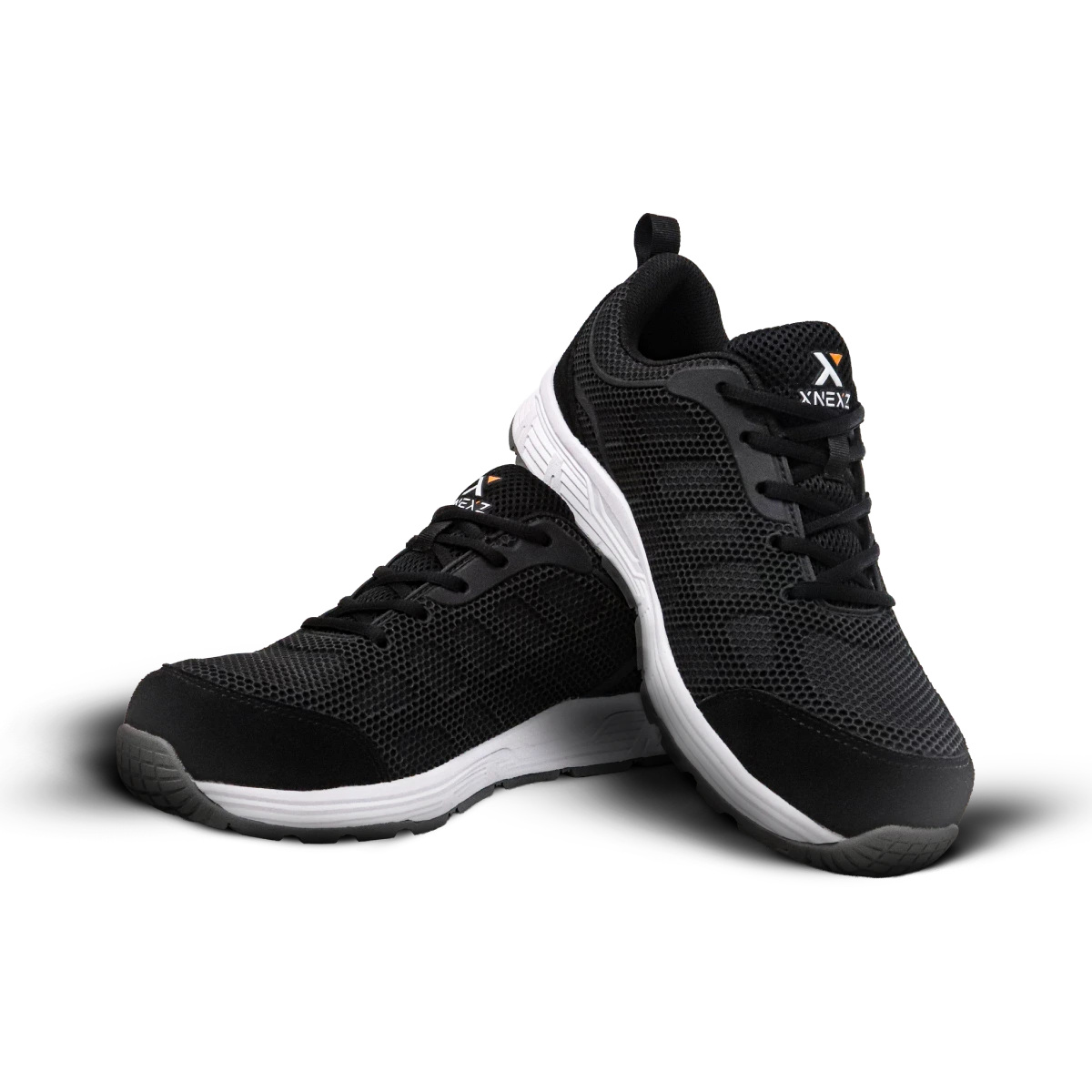
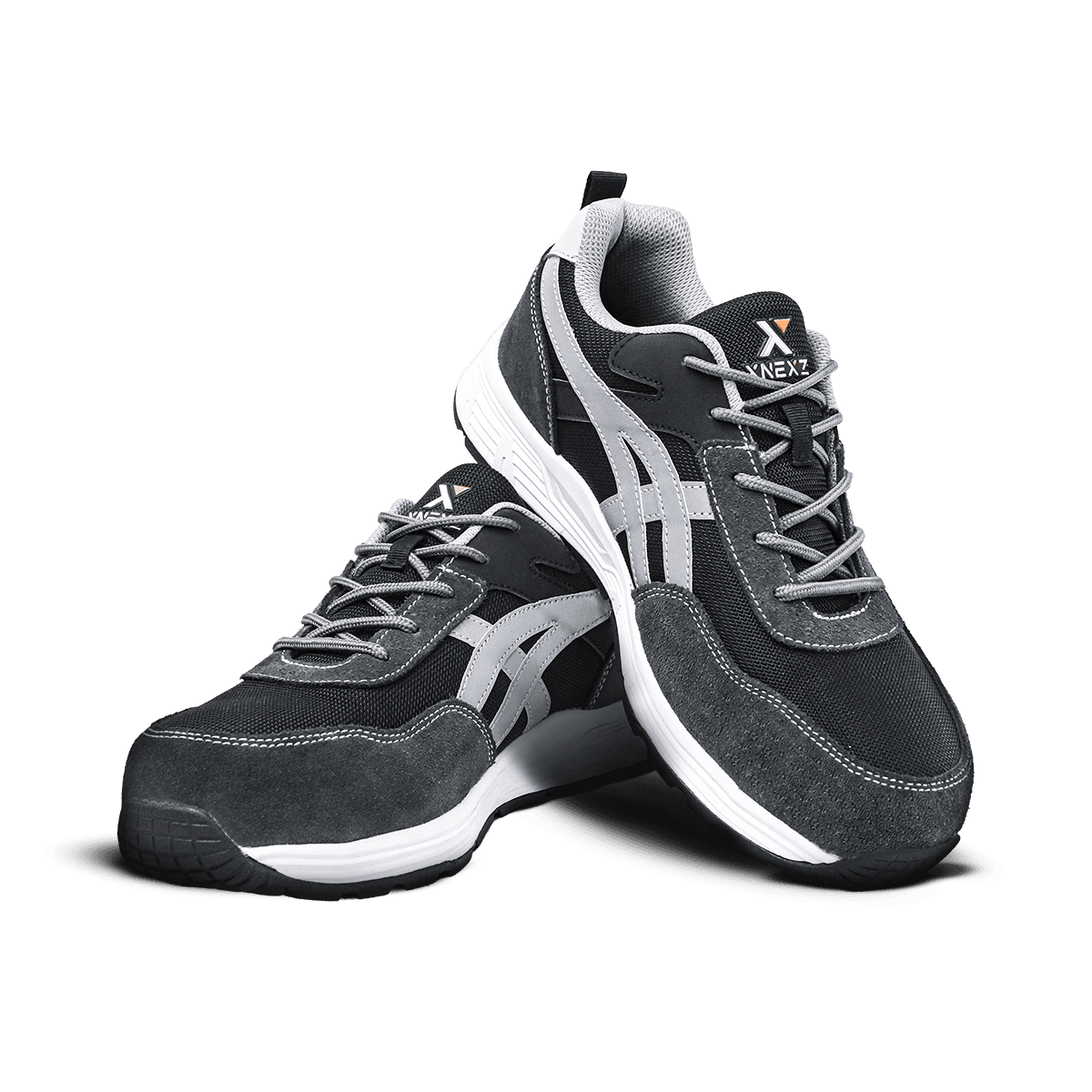
Two S1P trainers with shared protection and different characters — both designed for light-duty, indoor maintenance work.
Both share the same core build: a 200J aluminium toe cap, intended to provide certified toe protection while reducing weight compared with a comparable steel component; a Kevlar puncture-resistant midsole to help protect against screws, offcuts and sharp debris; a breathable mesh and microfibre upper intended to reduce heat and moisture build-up in warm plant areas; an anti-static design; an oil-resistant outsole; and a shock-absorbing heel for hours on hard floors.
- PulseX pairs that build with a PU outsole, offering cushioning suited to the smooth, controlled indoor floors common in offices, schools and healthcare buildings. It's the cleaner, smarter-looking option for occupied-building work.
- StrideX uses an EVA-and-rubber outsole for varied controlled indoor surfaces, with a more rugged, streetwear-inspired look for those who prefer it.
To be clear about the electrical point again: both models are antistatic, which is the standard S1P property - not electrically insulating. They are not suitable for live electrical working, and we'd rather say so plainly than let anyone assume otherwise.
What S1P - and XNEXZ - will not do
Honesty is part of how we'd rather sell shoes, so here are the limits stated plainly. Maintenance work is broad, and a light S1P trainer like the PulseX or StrideX is built for the dry, indoor, light-duty end of it. It is not a heavy-duty, outdoor, waterproof, heat-rated or insulating boot, and we won't pretend otherwise.
- Indoor building and fabric maintenance
- Caretaking, janitorial and site rounds
- Light repairs, fittings and general handyperson work
- Building services checks on dry indoor floors
- Live electrical work (needs EN 50321-1 insulating footwear)
- Persistently wet plant rooms or outdoor grounds (needs S3 / WR)
- Hot work, welding or molten-splash risk (needs heat-rated footwear)
- Heavy plant handling needing metatarsal protection
If your role sits in the right-hand column, the honest answer is that XNEXZ isn't the right choice, you should wear the protection your employer or safety officer specifies. Some maintenance staff working outdoors, on uneven ground, or needing ankle support may also prefer a boot to any low-cut shoe; that's the right call for those conditions, and our comparison of safety shoes vs safety boots explains when each wins.
Inspect your footwear - it's part of the job
Maintenance staff are often better than most at inspecting equipment, and safety footwear deserves the same treatment. Guidance on PPE foot protection consistently recommends routine inspection for cuts, holes, tears, cracks and worn soles, plus checking the sole for embedded metal or debris that could create a tripping or electrical hazard.
That last point is particularly relevant to this trade: a screw or metal fragment lodged in your sole from an earlier job is a genuine hazard you can carry into the next one. Give the soles a quick check between jobs, replace footwear once protection is compromised, and follow the manufacturer's care instructions.
Getting the fit right
A safety trainer's toe cap is rigid and doesn't stretch or break in, so the fit needs to be right from day one - for both comfort and protection. Leave roughly a thumb's width, about 10 to 15mm, between your longest toe and the front of the shoe. Measure your feet rather than assuming your usual size, do it later in the day when feet have swelled, and wear the socks you actually work in. Because maintenance work involves so much kneeling and climbing, a shoe that slips at the heel or presses at the toe will be noticed within hours. Our safety trainers size guide covers measuring and conversion step by step.
Frequently asked questions
Are antistatic safety shoes safe for electrical work?
No. Antistatic footwear dissipates static charge — it is not designed to protect against electric shock and cannot be relied on for that. Live electrical work requires footwear certified to EN 50321-1, chosen for the correct voltage class, alongside your other insulating PPE and safe working procedures.
Are S1P trainers suitable for facilities and maintenance work?
Often, yes — for indoor, dry, light-duty maintenance where safety footwear is required, S1P is a common and widely accepted level. But electrical, hot, persistently wet or heavy-plant tasks need different, specifically rated footwear. Your employer's risk assessment decides.
Does an oil-resistant sole mean it won't slip?
No — they're separate properties. Oil resistance (FO) means the sole survives contact with oil and fuel; slip resistance (SR) is the actual grip test. In plant rooms where both matter, check for the slip-resistance marking specifically rather than assuming.
Shoes or boots for maintenance work?
For indoor, high-step, kneeling-heavy work, a flexible low-cut trainer is often more comfortable. For outdoor grounds work, uneven ground, wet conditions or where ankle support is needed, a boot is usually the better and safer choice. Match the footwear to your actual conditions.
Which XNEXZ model suits maintenance work better?
Both share the same S1P protection and core build. The PulseX has a PU outsole and a cleaner, smarter look that suits occupied buildings like offices and schools; the StrideX has an EVA-and-rubber outsole and a more rugged style. Choose based on your surfaces and setting.
How often should I replace maintenance safety footwear?
There's no fixed interval — replace based on condition. Take footwear out of service if the sole is worn smooth or separating, the toe cap is damaged or exposed, the upper is torn, or after any significant impact. Inspect regularly, especially the soles for embedded debris.
The honest verdict
Facilities and maintenance work asks more of a single pair of shoes than most trades do, because the environment changes several times a shift. For the indoor, dry, light-duty portion of that work, building fabric, caretaking, light repairs, fittings and services rounds, where the employer accepts S1P footwear, a lightweight-feeling trainer like the XNEXZ PulseX or StrideX is a genuinely practical option: certified S1P protection, a puncture-resistant midsole, a slip-considered outsole, a flexible sole for kneeling work, and a smart look for occupied buildings.
But the honest headline for this trade is the electrical one. Antistatic is not insulation. If your work takes you onto or near live parts, you need EN 50321-1 footwear for that task, and no S1P trainer - ours included - is a substitute. Established brands also offer wider ranges, more fits, and specialist S3, heat-rated, metatarsal and insulating options that XNEXZ doesn't make; where your role needs those, they're the better and safer choice, and we'd rather tell you than oversell.
Work out which parts of your week each pair needs to cover, check what your employer requires for each task, and choose for the most demanding condition you face. That's how you end up protected and comfortable across a varied shift.
Try XNEXZ on your own shift
If your workplace accepts S1P footwear for your maintenance tasks and you'd like a more modern, lightweight-feeling option, try XNEXZ in your real workday, then tell us honestly how the fit, comfort, flexibility and grip hold up, and what we should improve. We're new, and we're listening. Not sure which model suits your buildings? Our S1P safety trainers buying guide can help you decide.


