


Ask anyone who's finished a twelve-hour ward shift what hurts, and the answer is rarely their back first. It's their feet. Healthcare staff cover serious mileage on hard, polished floors, dodge spills that appear from nowhere, and do it all while meeting infection-control rules that most industries never think about. That combination makes healthcare footwear genuinely tricky to buy, and easy to get wrong. Here's what actually matters, what the guidance says, and one honest warning about a material a lot of comfortable trainers are made from.
The short version
For most clinical roles, the priorities are slip resistance, a fully closed toe and heel, serious cushioning, and an upper you can wipe clean, not necessarily a steel toe cap. NHS uniform guidance points towards closed, supportive, low-heeled, soft-soled footwear that's washable or wipeable, with a secure fastening. Many clinical staff don't need certified safety footwear at all. Where they do, porters, estates, catering, logistics, S1P can make sense. One honest caution: infection-control policies often favour wipe-clean uppers, and some facilities specifically exclude fabric mesh, which rules out a lot of breathable trainers for patient-facing areas.
Why healthcare is uniquely hard on feet
Most jobs stress footwear in one direction. Healthcare manages several at once, which is why so many staff end up buying two or three pairs before finding something that works.
What does UK healthcare guidance actually say?

Here's the thing that surprises people: NHS footwear guidance is less about toe caps than you'd expect, and much more about closure, cleanability and support.
NHS uniform and dress policies consistently point in the same direction, footwear should encase the foot with closed toes and heels, have a secure fastening such as laces or Velcro for proper support, be low-heeled and soft-soled to reduce noise and support safe manual handling, and be kept in good repair and washable or wipeable. NHS England guidance also notes that for indoor slip resistance you want a well-defined tread pattern and a flexible sole.
"Footwear should encase the foot with closed toes and heels and have a suitable closing device such as Velcro or laces… Shoes should also be soft soled to reduce noise and be low heeled… Footwear should be in good repair and be washable or wipeable."
Notice what's not on that list for general clinical work: a steel toe cap. Which brings us to the most useful myth to bust.
Three healthcare footwear myths worth clearing up

Not true for most clinical roles. A nurse on a ward typically needs closed-toe, slip-resistant, supportive footwear, not certified impact protection. Toe caps become relevant where heavy items are handled: portering, estates and maintenance, catering, laundry, stores and logistics. Buying a toe cap you don't need adds weight you'll feel by hour ten. Your employer's risk assessment sets the requirement.
Comfort matters enormously, but a retail running shoe isn't tested for slip resistance on wet flooring, and many have mesh uppers that soak up spills rather than wiping clean. Comfort plus certified grip plus cleanability is the combination — and plenty of everyday trainers only deliver the first one.
Two different tests entirely. Oil resistance (FO) means the sole survives contact with oils without degrading; slip resistance is the actual traction test on wet or contaminated flooring. If grip is what you need — and in healthcare it is — check for the slip-resistance marking specifically, not the oil one.
That last point matters enough to repeat: our guide to non-slip safety shoes explains how to read the grip ratings, and why no shoe grips in every condition — housekeeping and prompt spill clean-up still do a lot of the work.
Different roles, genuinely different needs
"Healthcare" covers an enormous range of jobs, and the footwear answer changes depending on where in the building you spend your day.
| Role | Main priorities | Toe cap needed? |
|---|---|---|
| Ward nursing & HCAs | Grip, cushioning, closed toe, wipe-clean, quiet sole | Usually not required |
| Theatre staff | Closed toe, cleanable, easy on/off, antistatic where specified | Usually not required |
| Porters | Grip, cushioning, toe protection from beds, trolleys and cylinders | Often yes |
| Estates & maintenance | Toe cap, puncture midsole, grip, flexibility for kneeling | Yes |
| Catering & kitchens | Grip first, wipe-clean upper, hot-spill protection | Sometimes |
| Stores & logistics | Toe cap, grip, cushioning for high-step days | Often yes |
| Care home staff | Grip, cushioning, closed toe, cleanable, quiet | Usually not required |
A rough guide only, your employer's policy and risk assessment are what actually decide. For what the certification levels mean, see what S1P certification means and the S1 vs S1P vs S2 vs S3 ratings.
The mesh problem nobody mentions in the product description
Here's where we're going to be awkwardly honest, including about our own shoes.
Breathable mesh is what makes modern trainers light and cool, and healthcare staff are often desperate for both. But mesh is a porous fabric, and healthcare footwear guidance leans hard the other way. NHS policies specify footwear that's washable or wipeable, and some facilities go further and explicitly exclude fabric mesh from clinical areas, favouring leather, coated fabrics or synthetics you can wipe down.
The reason is straightforward: in a patient-facing environment, footwear may be exposed to blood or bodily fluids. A wipe-clean upper can be decontaminated properly. A fabric mesh upper absorbs, holds and is far harder to make hygienically clean.
If you work in a patient-facing clinical area, check your Trust or employer's footwear policy before buying any mesh-upper trainer, including ours. Many policies require a wipe-clean upper, and some name mesh specifically as unsuitable. A washable, wipeable shoe is the safer buy for clinical settings, and we'd rather you knew that upfront than found out at your uniform check.
Where XNEXZ fits in a hospital, and where it doesn't
XNEXZ is a new UK safety-footwear brand built on a simple idea: people who spend all day on their feet deserve footwear that feels good, looks modern, and still meets certified S1P protection for suitable settings. Both models — the PulseX and StrideX — are EN ISO 20345 S1P certified, lightweight, breathable and built for long shifts on hard floors.
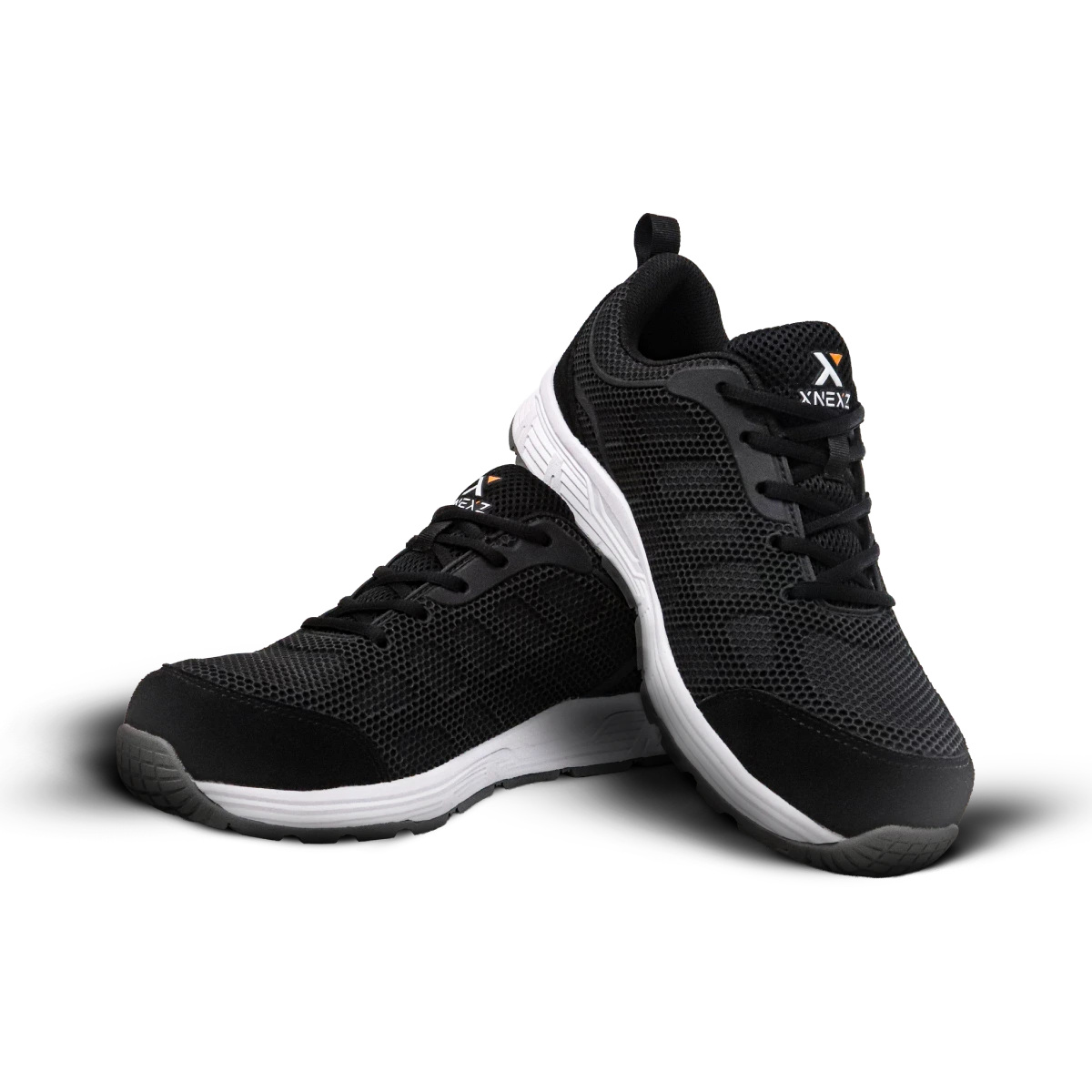
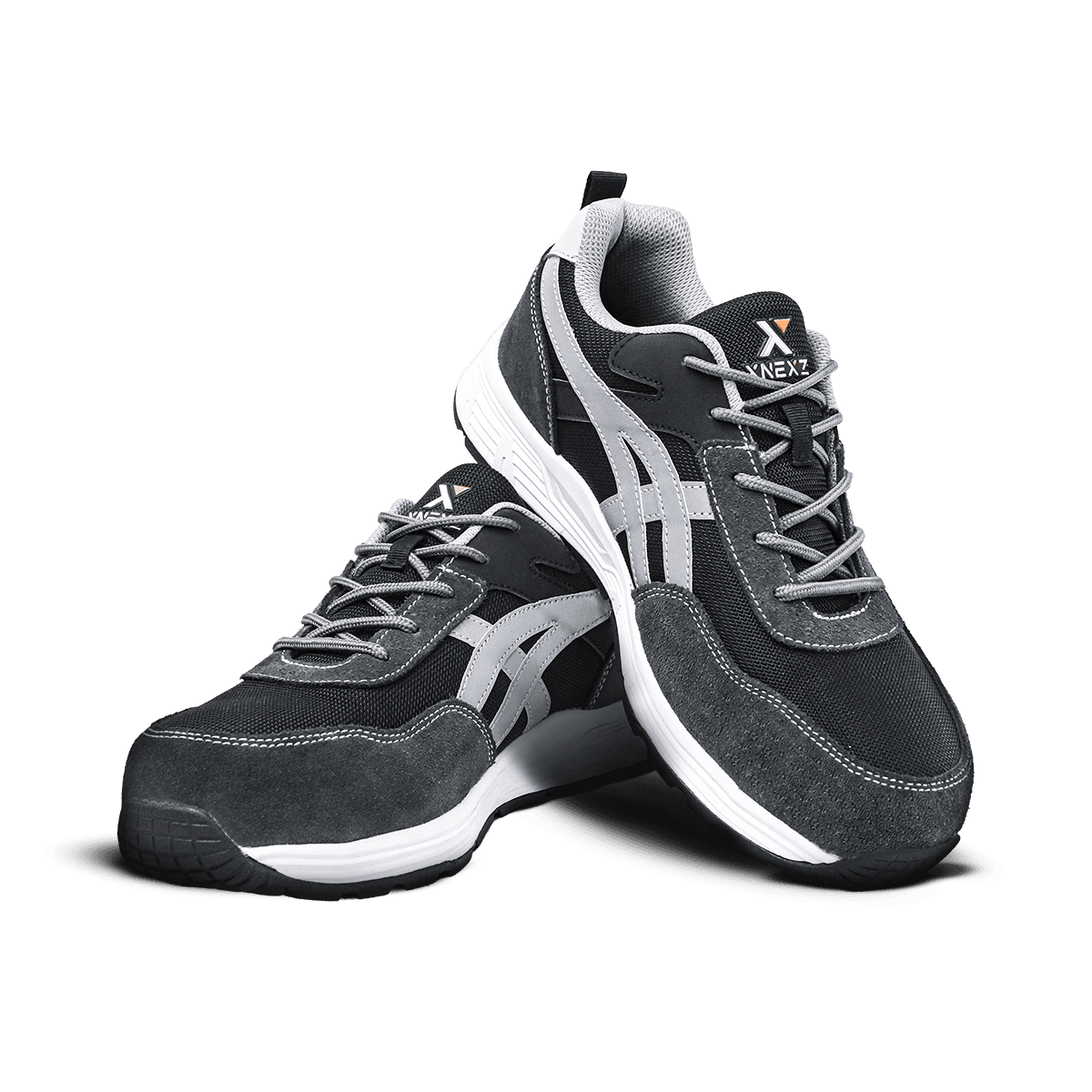
Both share a 200J aluminium toe cap, intended to provide certified toe protection while reducing weight compared with a comparable steel component; a Kevlar puncture-resistant midsole; a breathable mesh and microfibre upper intended to reduce heat build-up over long shifts; an anti-static design; an oil-resistant outsole; and a shock-absorbing heel for hours on hard flooring. The PulseX uses a PU outsole with a cleaner look; the StrideX uses EVA and rubber with a more rugged style.
Where that genuinely works in a healthcare setting is the non-clinical side of the building: portering, estates and maintenance, stores and logistics, laundry, and facilities roles where toe protection is useful and mesh isn't excluded by policy. Where it doesn't work is patient-facing clinical areas with a wipe-clean footwear requirement, and we'd rather say so than sell you a shoe your uniform policy won't allow.
- Portering and patient transport
- Estates, maintenance and facilities
- Stores, logistics and deliveries
- Non-clinical support and admin roles on hard floors
- Patient-facing clinical areas requiring wipe-clean uppers
- Theatres and areas with specific footwear protocols
- Kitchens with hot-liquid spill risk
- Any role where policy specifies a different rating or material
Buying well: what to actually look for
- Certified slip resistance: the single most useful property on a hospital floor. Look for the marking, not marketing language.
- Fully closed toe and heel: no open backs, no clogs without a heel strap. This is standard across NHS policies.
- A secure fastening: laces or Velcro, so the shoe stays put when you move fast.
- Serious cushioning and arch support: twelve hours on vinyl is brutal without it, and poor support contributes to plantar fasciitis.
- A wipe-clean upper: leather, coated fabric or smooth synthetic for clinical areas.
- Low weight: you're lifting these shoes thousands of times a shift; see the hidden cost of heavy safety shoes.
- A quiet, soft sole: genuinely appreciated on a night shift.
- A low heel: supports safe manual handling and reduces slip risk.
Getting the fit right (feet swell - plan for it)
One practical tip that saves a lot of misery: your feet at 7am and your feet at 6pm are not the same size. Feet swell across a long shift, sometimes by close to half a size, so a shoe fitted first thing in the morning can feel unpleasantly tight by the afternoon.
Measure or try footwear later in the day, wear the socks you actually work in, and leave roughly a thumb's width, about 10 to 15mm, in front of your longest toe. If you're buying safety footwear with a toe cap, this matters even more, because the cap is rigid and will never stretch to accommodate your foot. Our safety footwear size guide covers measuring and UK/EU conversion properly.
Keeping them clean (and knowing when to let go)
In healthcare, footwear hygiene isn't optional, and worn footwear is both a slip risk and a cleanliness problem.
- Wipe down after every shift: it's an infection-control expectation, not just good habit.
- Check the tread: grip is doing most of the protective work, and a worn-smooth sole has lost it regardless of the original rating.
- Replace on condition: cracked soles, separation at the bond line, torn uppers or a flattened, dead midsole all mean it's time.
- Report damaged or soiled footwear: NHS dress policies typically ask staff to raise it with their manager rather than keep wearing it.
Our guide to safety shoe care and when to replace covers cleaning by material and the signs to watch for.
Frequently asked questions
Do nurses need steel toe cap shoes?
Usually not. Most ward-based clinical roles need closed-toe, slip-resistant, supportive and cleanable footwear rather than certified impact protection. Toe caps are more relevant for portering, estates, catering and logistics roles where heavy items are handled. Your employer's risk assessment decides.
Can I wear mesh trainers on a hospital ward?
Check your Trust's uniform and infection-control policy first. NHS guidance points towards washable or wipeable footwear, and some facilities specifically exclude fabric mesh from clinical areas because it absorbs spills and is harder to decontaminate. Non-clinical roles often have more flexibility.
Are clogs allowed in healthcare?
Only closed-toe, closed-heel styles with a secure fastening and a slip-resistant sole. Open-backed styles don't meet the "encase the foot" requirement in most NHS dress policies and offer no protection from dropped items.
What's more important, grip or cushioning?
Grip, then cushioning. Slips cause sudden, serious injuries; poor cushioning causes cumulative pain and fatigue. Ideally you want both, but if you're choosing, certified slip resistance addresses the sharper risk.
Does my employer have to provide my footwear?
If a risk assessment identifies safety footwear as necessary PPE for your role, UK regulations require employers to provide it free of charge. Where footwear is a uniform or dress-code matter rather than assessed PPE, arrangements vary, check your Trust or employer's policy.
How often should healthcare footwear be replaced?
On condition rather than a fixed date. Replace once the tread is worn smooth, the sole is cracking or separating, the cushioning has flattened, or the upper is damaged or can no longer be cleaned properly. Heavy mileage wears soles faster than most people expect.
The honest verdict
Healthcare footwear is a balancing act that most industries never have to attempt: grip that handles sudden spills, cushioning that survives twelve hours on vinyl, a closed and secure fit, low weight, a quiet sole, and an upper that infection control will actually approve of. Get slip resistance right first, then cushioning, then cleanability, and check whether your role genuinely needs a toe cap before paying for weight you don't need.
As for us: XNEXZ makes lightweight S1P trainers that work well for healthcare's non-clinical roles, portering, estates, logistics, facilities, where toe protection helps and mesh isn't excluded. For patient-facing clinical areas where policy calls for a wipe-clean upper, a dedicated healthcare shoe from a specialist brand is the better and more compliant choice, and there are excellent ones out there built specifically for ward work. We're a new brand, and pointing you to the right shoe matters more to us than a sale that gets flagged at your uniform check.
Whatever you buy: check your policy, fit it late in the day, and replace it before the tread gives up. Your feet are doing more miles than almost anyone else's.
Try XNEXZ on your own shift
If you work in portering, estates, logistics or another non-clinical healthcare role, your employer accepts S1P footwear, and you'd like something lighter for long shifts, try XNEXZ in your real workday, then tell us honestly how the grip, cushioning and comfort hold up, and what we should improve. We're new, and we're listening. Working a clinical area with a wipe-clean footwear policy? Follow it, it matters more than any brand preference. Our S1P safety trainers buying guide can help you compare.


