


Same S1P safety class, two completely different tools. The DeWalt Laser is a rugged steel-toe leather hiker boot built for tough, outdoor work.
The Xnexz StrideX is a lightweight, metal-free trainer built for long indoor shifts. Below is an honest, spec-by-spec breakdown of how they compare, and, more importantly, which one actually fits your working day.
Quick answer
The DeWalt Laser is cheaper (~£55), tougher, offers ankle support and the top SRC slip rating, the better choice for construction, engineering and outdoor site work. The Xnexz StrideX (£79.97) is far lighter, more breathable, metal-detector-friendly and certified to the current 2022 standard, the better choice for warehousing, logistics and hospitality. Neither wins outright: pick the boot for rough ground, the trainer for high-step indoor shifts.
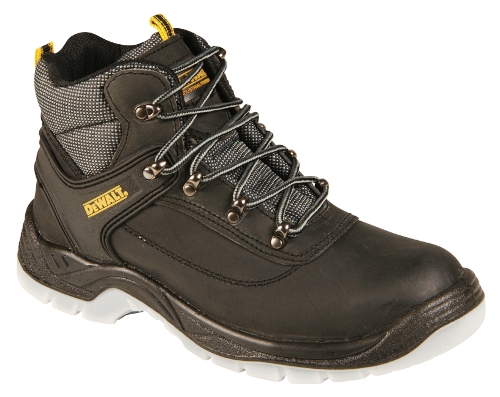
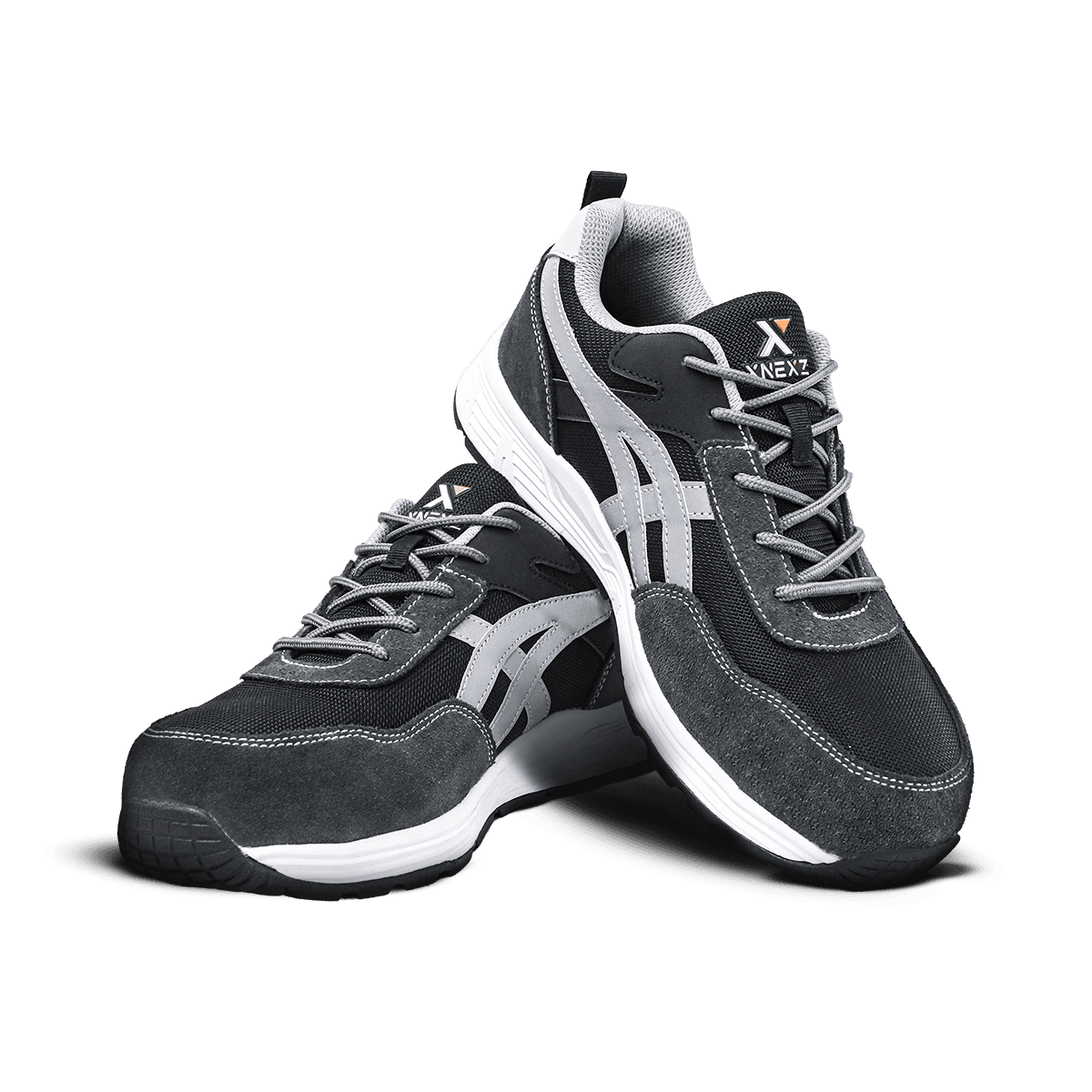
Two S1P options, two philosophies: a rugged steel boot versus a featherweight metal-free trainer.
What's The Real Difference Between the DeWalt Laser and Xnexz StrideX?
On paper they share the same headline: both are certified S1P safety footwear with a 200-joule toe cap, a puncture-resistant midsole, antistatic properties and an energy-absorbing heel. That's where the similarity ends.
The DeWalt Laser is a hiker-style ankle boot with a nubuck leather upper, a steel toe cap and a steel penetration-resistant midsole. It's designed to take punishment on rough ground.
The Xnexz StrideX is a low-cut trainer with a breathable mesh-and-microfibre upper, an aluminium toe cap and a flexible Kevlar midsole. It's designed to keep you light and cool across a long shift on flat floors. Here's how the categories fall:
Five categories each, this is a genuine split, and the "winner" depends entirely on the job.
Is a Steel Toe Cap or an Aluminium Toe Cap Better?
Both caps must pass the identical EN ISO 20345 test: a 200-joule impact and a 15-kilonewton compression. Protection at that threshold is the same. What differs is everything around it.
A steel toe cap, like the DeWalt's, is proven, robust and inexpensive to produce, which is part of why the Laser is so keenly priced. Its downsides are weight, cold transfer (steel conducts, so toes feel colder in winter) and the fact that it will set off a metal detector.
An aluminium toe cap, like the StrideX's, is a non-ferrous metal that hits the same 200J rating at roughly 30% less weight. It's slimmer in profile, doesn't conduct cold as aggressively, and is far friendlier around detection gates. The trade-off is a higher production cost, reflected in the price.
- Same protection: both certified to 200J impact / 15kN compression.
- Weight: aluminium is about a third lighter for the same protection.
- Cold: steel transfers cold faster; aluminium and composites less so.
- Detection: steel triggers gates; aluminium is far less likely to.
For the full engineering picture, our guide to aluminium toe vs steel toe caps breaks down the density, cost and comfort differences in detail.
Steel Midsole vs Kevlar Midsole, Which Protects Your Foot Better Underfoot?
The midsole is the anti-penetration layer that stops a nail or sharp object driving up through the sole. Both shoes carry one, and both meet the minimum puncture resistance required for the "P" in S1P. The difference is the material, and how it feels.
The DeWalt uses a steel plate: a single rigid sheet that resists penetration by being stiff. That stiffness is also its drawback, a steel plate resists bending exactly where your foot naturally flexes, which is why steel-midsole boots can feel like "walking on a board."
The StrideX uses a Kevlar (para-aramid) insert: a tightly woven textile that stops the same sharp objects while remaining pliable. It flexes with the roll of your foot through each step, so the sole moves with you rather than against you. It's also lighter and, being non-metallic, doesn't conduct cold or trigger detectors.
| Midsole | DeWalt - Steel | StrideX - Kevlar |
|---|---|---|
| Puncture protection | Meets S1P minimum | Meets S1P minimum (PL) |
| Flexibility | Rigid plate | Flexes with the foot |
| Weight | Heavier | Lighter |
| Cold transfer | Conducts cold | Does not conduct |
| Metal detectors | Triggers | Detector-friendly |
Both stop the nail; only one bends with your stride. See Kevlar vs steel midsole for the test data behind this.
Which safety shoe is lighter, and does the weight really matter?
Yes, and it's the single biggest day-to-day difference between these two. A steel toe, a steel midsole and a leather boot shell add up quickly. A lightweight trainer with aluminium and Kevlar simply weighs less on every step.
Illustrative. StrideX states ~450–550 g per shoe; DeWalt doesn't publish a figure, but steel-toe + steel-midsole leather boots typically sit around 1.3–1.5 kg per pair. Confirm exact weights before buying.
Why does a few hundred grams matter? Because you lift each foot thousands of times a shift. Over 10,000 steps, an extra 200 g per foot is a tonne of additional lifting effort, every day, compounding across a week. On a construction site where you're standing and climbing, that mass buys you ruggedness. On a warehouse floor where you're walking constantly, it just makes you tired.
If your role is high-step and indoors, this is decisive. Our breakdown of the hidden cost of heavy safety shoes shows how footwear weight translates into real end-of-shift fatigue and lower-limb strain.
Boot or Trainer, Which Upper Suits Your Workplace?
This is where the two diverge most, because they're built for different ground.
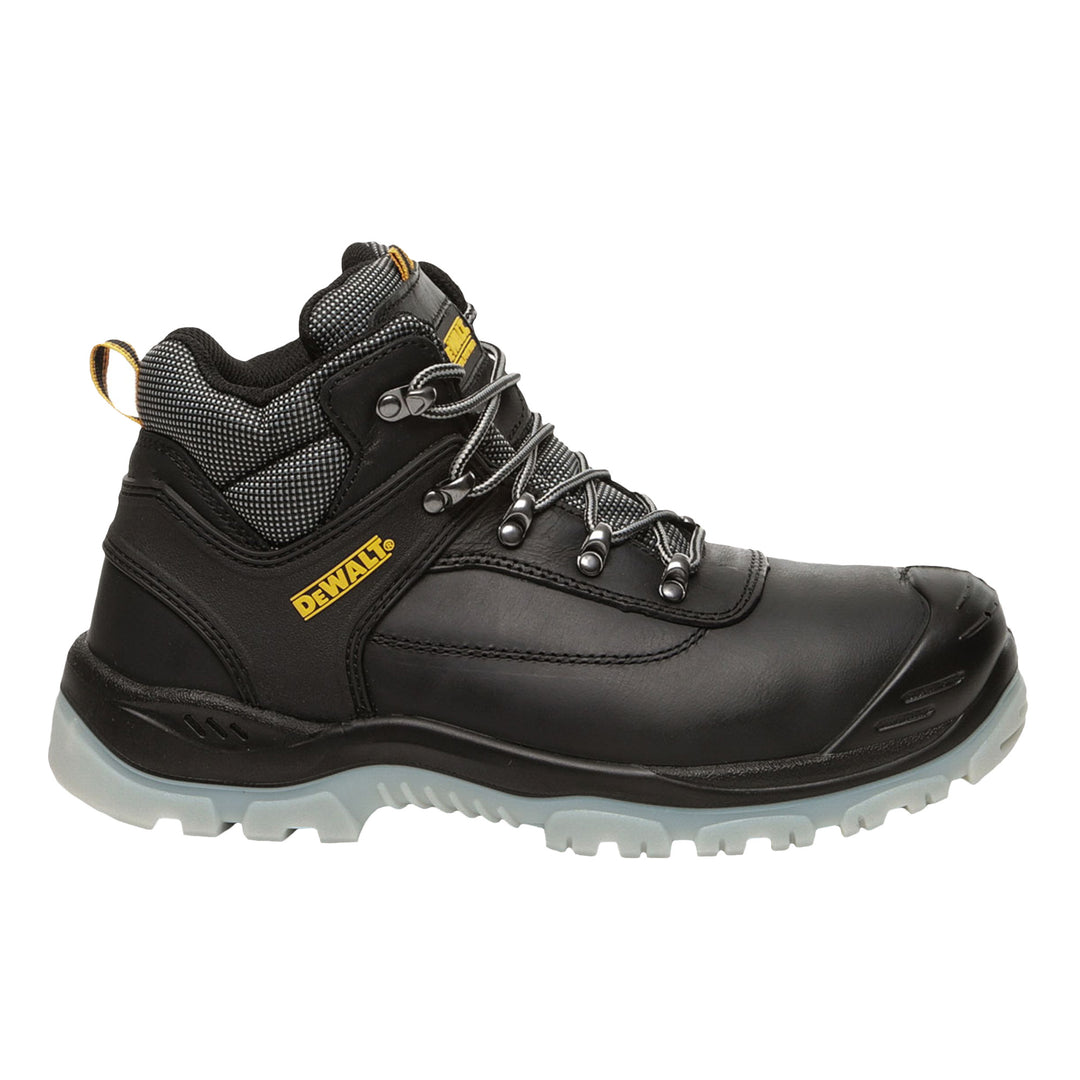
- Nubuck leather upper: shrugs off abrasion, scuffs and wet-site knocks far better than textile.
- Ankle height: adds support and keeps debris out on rough, uneven terrain.
- Robust build: is at home in construction, groundworks and engineering.
- Trade-off: a closed leather boot runs hotter and heavier over a long indoor shift.
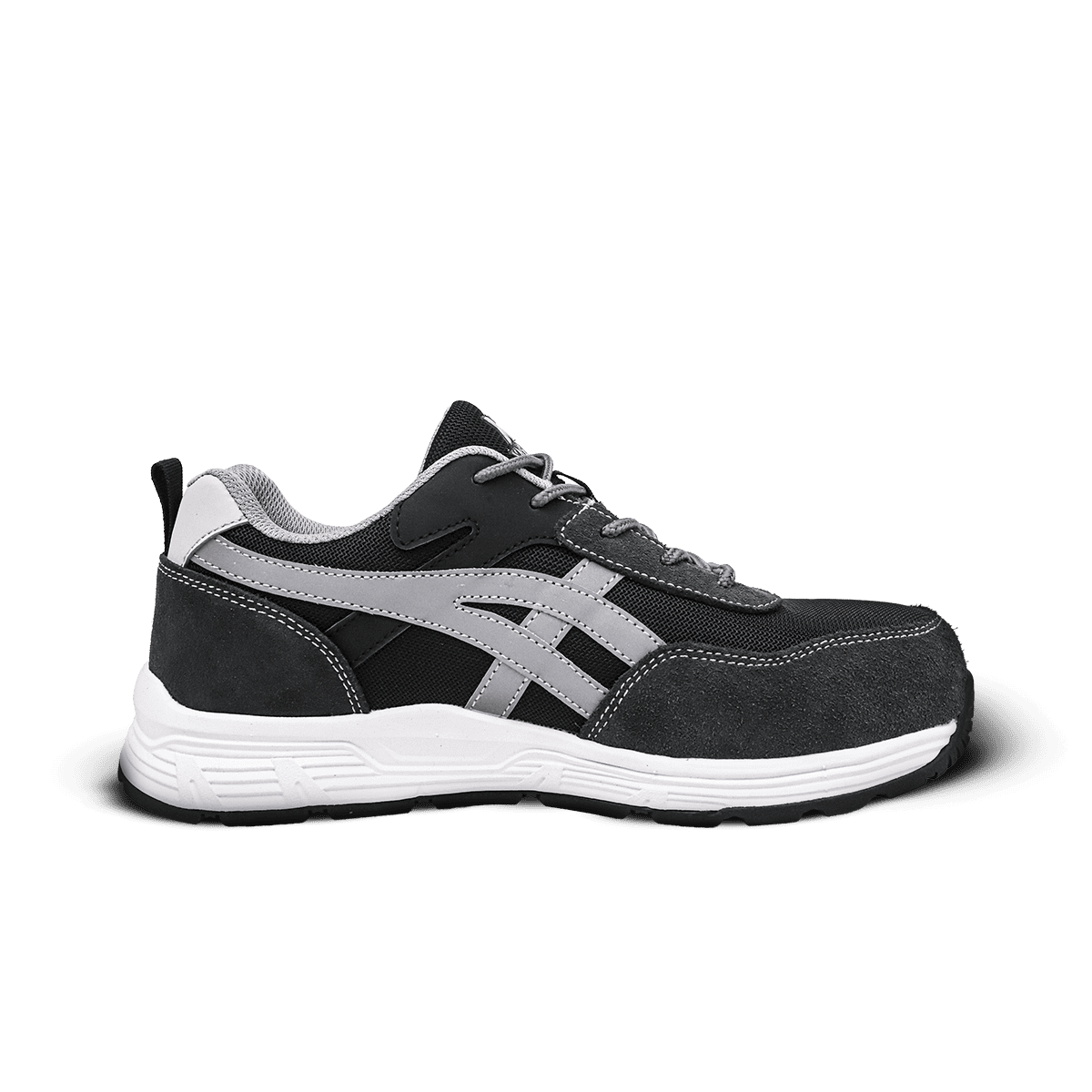
- Mesh + microfibre upper: lets air move, keeping feet cooler and drier over long hours.
- Low-cut trainer: feels lighter and more natural for constant walking on flat surfaces.
- Metal-free construction: suits food production, pharmaceuticals and secure sites with detection gates.
- Trade-off: mesh isn't as abrasion- or weather-resistant outdoors as leather.
It's the classic mesh vs leather upper trade-off: airflow and low weight, or armour and weather resistance. One extra note, an S1P shoe is not a waterproof-rated shoe.
The Laser's leather is naturally water-resistant when maintained, but for genuinely wet outdoor work you'd want an S3/WR-rated boot; neither of these is that.
What do the slip ratings (SRC vs SR) actually mean?
Slip resistance is one of the most misread markings on a safety shoe, so it's worth being precise.
- SRA tests grip on a wet ceramic tile with a soapy solution, think kitchens and washrooms.
- SRB tests grip on a smooth steel floor with glycerol, think oily, greasy industrial floors.
- SRC means the shoe passed both tests, the most complete slip credential available under the older standard.
The DeWalt Laser carries SRC, so it's proven across both wet and oily conditions, a genuine strength. The StrideX carries SR, the slip marking under the newer 2022 standard, which revised how slip testing is classified.
Both are certified for slip resistance; the DeWalt's SRC simply spells out the two specific surfaces it was tested against. If grip on varied contaminated floors is critical to your role, that's worth weighing, our guide to non-slip safety shoes explains how to match a rating to your floor.
Does The Certification Standard (2011 vs 2022) Make a Difference?
The DeWalt Laser is certified to EN ISO 20345:2011; the StrideX to EN ISO 20345:2022+A1:2024. Both are valid, a product certified under the 2011 edition remains legitimately certified and safe to wear. The 2022 revision is simply the current one, and it updated several areas, including the non-metallic puncture markings (PL and PS) and the slip-resistance classifications.
For most buyers this isn't a dealbreaker; a well-made 2011-certified boot protects you exactly as it was tested to. But if you specifically want footwear proven to the latest published standard, the StrideX has the edge here. Either way, the marking on the label tells you what the shoe was tested to, and it's always worth checking.
How much do they cost, and which is better value?
Value depends on what you actually need, so here's the honest arithmetic.
The DeWalt is the better budget buy, full stop, you get a rugged, established steel boot with a top slip rating for around £55. The StrideX costs more, and it isn't trying to win on price. What its £79.97 buys is the lighter aluminium-and-Kevlar construction, the breathable build, the current certification and a 90-day return with a 1-year warranty. If your priority is the lowest sticker price for tough work, the DeWalt wins.
If your priority is weight, comfort and metal-free construction for indoor shifts, the StrideX earns its premium.
DeWalt Laser vs Xnexz StrideX: which one should you buy?
Match the shoe to your ground and your shift first, budget second.
- You work outdoors or on rough, abrasive ground
- You want ankle support and a rugged leather boot
- You need the top SRC slip rating
- Lowest price is your priority
- Steel toe is accepted (no detector gates)
- You're on your feet indoors for long, high-step shifts
- Weight and breathability matter most
- Your site uses metal detectors
- You want current 2022 certification
- You value a 90-day return and 1-year warranty
Still deciding? Our S1P safety trainers buying guide walks through every marking and what to check before you commit. And remember: your employer's risk assessment always has the final say on what's approved for your site.
Frequently asked questions
Is the DeWalt Laser waterproof?
No, it's rated S1P, not S3 or WR. The nubuck leather is naturally water-resistant when kept conditioned, and some retailers describe it as "water-resistant," but it is not a certified-waterproof boot. For standing water, deep mud or prolonged rain, you'd want a boot carrying the WR (whole-shoe water resistance) marking.
Are these safety shoes suitable for construction?
The DeWalt Laser is the better fit for construction and outdoor site work, the leather upper, ankle support and steel components are built for it. The StrideX is a light-duty indoor trainer; it's certified S1P but designed for warehouse, logistics and hospitality environments rather than heavy site work. Always follow your site's PPE requirements.
Can I wear the StrideX through metal detectors?
It's far more detector-friendly than the DeWalt. The StrideX uses an aluminium (non-ferrous) toe and a non-metallic Kevlar midsole, so it won't trigger detectors tuned for ferrous metal, though very sensitive gates can register aluminium's conductivity. The DeWalt's two steel components will trigger gates. For strict metal-free environments, verify any shoe against your specific detector setup.
Which is more comfortable for standing all day?
It depends on the surface. On hard, flat indoor floors, the StrideX's lighter weight, flexible Kevlar midsole and breathable upper generally feel more comfortable over a long shift. On rough or uneven ground, the DeWalt's ankle support and rugged sole provide more stability. Comfort is personal, so try your usual size in your actual working conditions.
How long do these safety shoes last?
There's no fixed expiry, but daily-wear safety footwear typically shows meaningful wear within 6–12 months. Replace either shoe immediately after a serious impact, or once the sole is worn smooth or separating, the toe cap is deformed, or the upper is torn, regardless of age. Condition, not the calendar, decides it.
The verdict
This isn't a knockout, it's two tools for two jobs.
- DeWalt Laser wins on price, ruggedness, ankle support, SRC slip rating and brand pedigree. It's the better boot for construction, engineering and outdoor site work.
- Xnexz StrideX wins on weight, breathability, metal-free construction, current certification and after-sales terms. It's the better trainer for warehouse, logistics, healthcare and hospitality.
If you're outdoors on rough terrain and counting the pennies, the steel DeWalt is the smart buy. If you're indoors clocking big step counts and need to stay light, cool and detector-safe, the StrideX is built for exactly that. Match the shoe to your ground and your shift, and you'll get the right one either way.


